
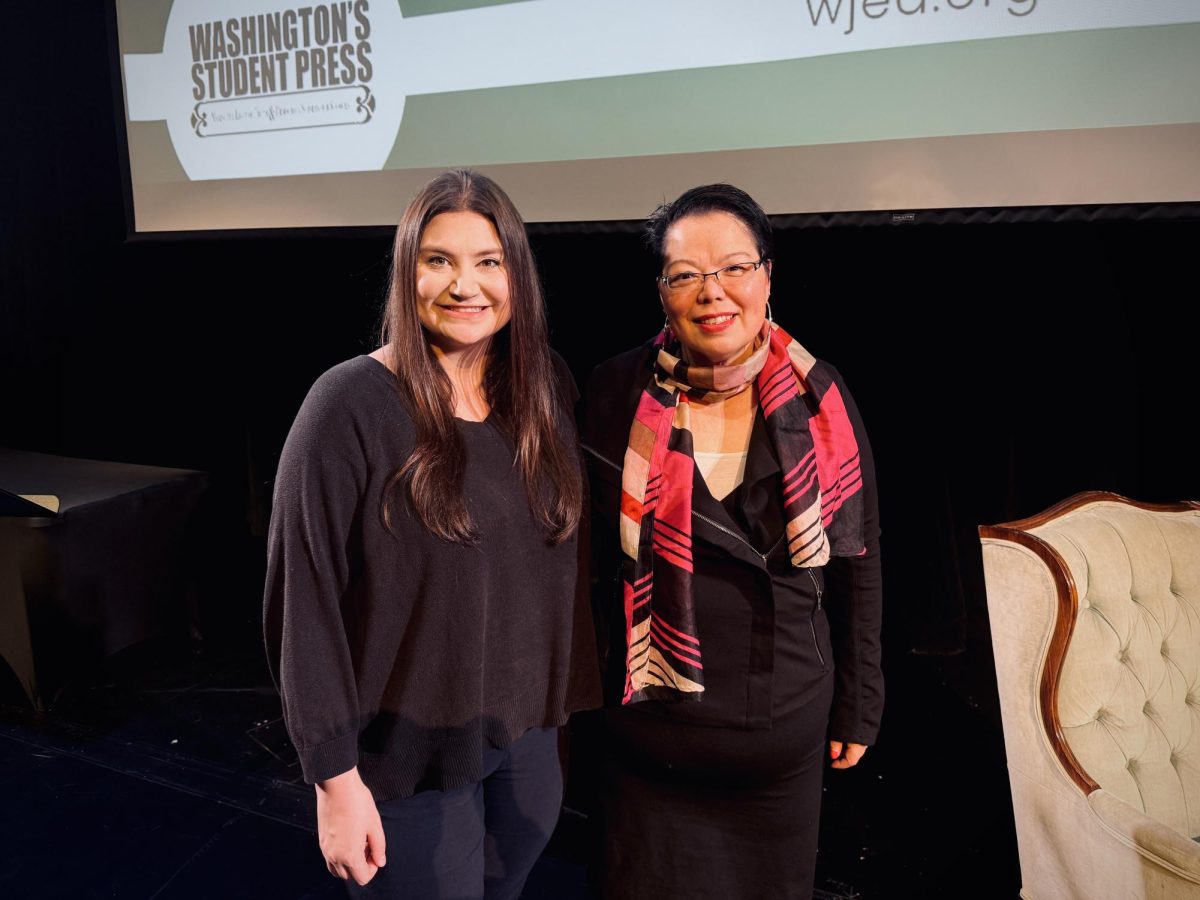
It’s hard to determine what the most salient piece of journalistic wisdom dropped by the Seattle Times Social Justice columnist, Naomi Ishiska, who spoke to student journalists from 16 high schools around the state at the WJEA Write off and competition on March 7 in the beautiful auditorium of the South Central Kitsap High School. But let’s start with the essentials.
“How do you know what you know?” asked Ishisaka, responding to moderator Mariah Lane, a former FOX producer and now a digital media specialist for Everett Public Schools. She asked the former student journalist now assistant managing editor for diversity, inclusion and staff development why journalism was vital for a community.
“How do you know what’s going on in your city? How do you know what’s going on in your state government? Everything that we think we know, we got because someone had bothered to find that information out for us for the most part,” said Ishisaka sitting on a Victorian era couch across from Lane. “I think that’s what public service journalism does. That’s what good journalism does. And I think that’s why the work that we do is so vital, and it’s why it’s so exciting to see so many of you in this room who are interested in carrying on that work, because it’s vital to a healthy democracy.”
Ishisaka, an alum of Garfield High School and former editor of The Messenger told the crowd that she was a quiet student who comes from a family centered around social work and education. Her father, a former associate professor at the UW school of Social Work, was born in a Japanese concentration camp in Colorado, which gave her a deep sense of the injustice that can happen to a group of people.
“We had a lot of issues around race and systemic racism at the school, and the paper was a way to address some of those things. So, I really saw it as sort of an extension of some of the things that I grew up caring about and growing up being passionate about through journalism.”
Ishisaka has held many jobs in the industry, from copy editing, to reporting and photography. She was a founding editor of ColorsNW Magazine, a monthly magazine focusing on communities of color in the Northwest.
She has continued her work for the Seattle Times, taking on the issues that grip her native city of Seattle, the state and the nation, from the gun violence that recently took the lives of two students at Rainier Beach, to the farm workers whose livelihoods were impacted by the flooding in Skagit county, to an interfaith, LGBTQ gospel choir that brings community through voices joined in song.
In one of her most recent columns she confronted the varying perspectives of the Iranian community when it came to covering the recent war in Iran.
“I don’t believe in the idea that journalists give voice to the voiceless,” she said. “I don’t think that’s true. I think everyone has a voice. I think what we can do is amplify those voices and shine lights on voices that often don’t get heard. But everyone has a voice. It’s just a question of whether or not anyone bothered to ask what it was.”
Many students lined up with thoughtful questions, before going off to write in various contests. Students who competed in the news writing and feature writing competitions were asked to write about the thoughtful discussion.
Others attended some of the many speakers lined up, attending classes like Storytelling 101, Pages that Pop, Public Reporting in the age of Misinformation, Indesign tips and tricks from the printers perspective and covering tragedy, taught by a new advisor to our community who was an advisor at Marjory Stoneman Douglas High School in Florida during the 2018 mass shooting event.
Here is more from Ishiska’s conversation with Mariah Lane and the excellent questions from the up and coming journalists of Washington State.
Be who you are:
Show up exactly who you are as an authentic person in this industry. The diversity of our industry is what allows us to tell the truth of our communities most accurately. And if we have rooms that are made up of people where everyone looks the same, we’re going to miss out on so many important stories that need to be told. However you show up in the world is how you should show up to journalism. You shouldn’t let anyone tell you you need to be different, or that a part of you doesn’t fit; none of that is true. If you have a newsroom like that, you’re in the wrong newsroom, or you need to change that newsroom, because a newsroom that is worth its weight, in my opinion, is one that really embraces every facet of the diversity of everyone who shows up and will really see that as an advantage and not any kind of deficit.
Opinion must be grounded in Research:
My job is not to just wake up and just spout whatever came off the top my head that day, right? It is completely not that. There is so much research and rigor that has to go into column writing, especially news column writing, because we are responsible for everything that we say and write. So, for example, my column this week was on the war in Iran, which wasn’t something that had happened until February 28th. So I had to pivot this week, to start thinking about something that I had fairly limited knowledge – some knowledge – but not enough to feel confident at all writing anything about it. So, I started to do a deep dive into whatever I could learn and understand. One of the things that was the most challenging to wrap my head around was a lot of the internal politics within the Iranian American community. There’s different groups that have different perspectives on what is the best path forward for Iran. There’s a lot of folks who have experienced a tremendous amount of trauma displacement, and I had to be really sensitive to those nuances while trying to get a sense of the larger picture of the community’s perspective and how it sort of fit into some of the narratives I’ve been seeing. So, it was a big learning curve. I also have to learn things like, what the different flags that I’ve seen at a protest mean, right? They mean a lot. So, whatever we end up doing in terms of a photo, we put with a story,, we put the column, we have to be thoughtful about.
Be accountable for every fact:
With a reported column, I have to be accountable for everything that I write, and that includes everything that other people say too. Like, I can’t interview someone and have them say, Well, this is the worst mass shooting that ever happened, if it wasn’t the worst mass shooting that ever happened, right? Because I’m putting that out there as a fact that might not be a fact. So, I have to make sure every single detail in my column is vetted. I check it, I check it again, I check it again. Have an editor check, have a copy editor check it. Everyone has to make sure that 100% of the things that I write in my column are factually sound or based in evidence and can be defended if I get challenged, and I will get challenged every single time. So, I can’t just wing it. And I would say no one in my role could just sort of wing what they write and say in a column like mine. So, if people think it’s like an easier path to getting their opinions out there, I would say it’s not. Are there places to do it better, easier, sure, but if you’re going to try to do it for a metropolitan daily newspaper, that’s not the place to do it.
Be on the front lines of dispelling Disinformation:
I think even just this past week, we’ve seen how misinformation, disinformation is just flying on social media right now. It always has been, but I think right now when AI is exploding, and more importantly, people don’t have the ability to discern whether it’s happening or not, that puts us in a really, really precarious moment and really precarious time? We’re seeing folks very, very well informed, thoughtful people, inadvertently sharing AI images, AI driven stories. I mean, it’s pervasive, and so I think that it’s incumbent upon all of us, especially folks in journalism and the media, to be on the vanguard of vigilance around that. There are best practices for debunking. There’s best practices for language, so I think those of us who are in the business of telling accurate truths about our world and our communities should be really on the front lines of making sure that we’re not spreading misinformation, we’re teaching our communities how to be watchful and identify [the misinformation], and that means that we have to learn how to do it.
On why having a school newspaper is important:
That’s such an existential question. Why should they read the newspaper? I guess because I would hope that they would be curious about what’s going on in their school and want to have a deeper understanding so they could make better decisions about how they choose to use their time and what they understand to be the truth of what’s going on in their school. I mean, certainly, I think about it in terms of The Seattle Times, like, how do you get people to be interested in reading The Seattle Times, but in the school student newspaper, you would think that they would just be super excited to see the work of their peers and to read about someone in the school, because no one else in the world is going to cover it. I say that about city newspapers too. I think there’s a lot of people that take that work for granted, and they think, Oh, well, it’s always going to be there. I don’t really care. It doesn’t really matter, but it’s like, you don’t know what you’ve got until it’s gone. And I think with a student paper, the same thing. If no one was reporting the things you are reporting on, no one else in the world would ever report on it. It’s just true.
On Making Mistakes:
[Mariah Lane] I remember when I was in high school, I took part in a student program at The Seattle Times, and part of our training was, we had to go through their ethics training, and talk about, okay, if you mess up, don’t hide it. Come and own it. You fix it, you address it, and you move forward. And I think that that’s the most important thing to do. I was told in journalism school you’re gonna make 200 mistakes, so you better start, and then once you reach that [number] you make 200 more. So it’s good to learn how to go through those for sure.
(Ishisaka) And one of the things that we do in our corrections policy, which I think is really smart, is we ask, how do we get to this place, right? And I think that step is really important, not to cast blame, or to, you know, shame or anything like that. It’s more, how can we avoid this mistake in the future? What were the steps that led us [here].
Stay Curious:
I’m an incredibly curious person, so I’ve got a million questions about everything, and I’m always looking around for things that help weave connections to other things. And, you know, just driving here and seeing the ships in the harbor, like, Huh? I wonder what their ships are doing here. I wonder where they’re going, what their purpose, you know, all these different things that kind of connect our world, I’m just deeply curious. And so I think that curiosity is what makes journalism such a wonderful career. And I think anyone in journalism is starting with that curiosity, and I think continuing to nurture it, and never stop being curious. Never stop trying to learn. Never stop opening doors to other paths that you might not even know you could be interested in. I mean, I think that’s what makes this such a wonderful career.
Don’t let AI do your Learning:
I’m probably a dinosaur on this. I don’t know what the teachers in the room think, but my take on it is, those [journalism skills] are really good skills to develop as part of your, not just a journalism skill set, but just as a student learning on how to write and and do any kind of class work at all, is to do those things by yourself. So, I guess my take on it would be, do it the old fashioned way, do it the hard way, and I think that will reap benefits going forward. I mean, there’s so many mistakes that get made just by human error that I can’t imagine that not having the skills to learn how to do it well and do it right wouldn’t benefit you long term. And I can’t imagine that if you would use an AI tool, I can’t imagine that they would be more accurate. It might save some time in the short term, but I think in the long term, it would actually cost more than it’s worth, personally. Again, I’m probably a dinosaur on this, but I find that to be a concerning development if that’s the path that folks are taking for such important work. I mean, there’s a craft, there’s an art in writing a caption. There’s a craft and an art in writing a story. There’s craft and an art in writing a headline. I’m terrible at writing headlines. I would love it if a computer could come and make all the headlines brilliant and beautiful for me, but I need to challenge myself. I’ve been trying to challenge myself to get better, to really refine those skills, to gain those skills and gain the confidence to do it better. If I just run them through Chat GPT, which I could absolutely do, it wouldn’t help me grow in that way, and I think that would be doing myself a disservice.
The internet is forever:
Yeah, I mean, I guess to me, it gets back to that point I was making earlier about credibility. I’ve seen a lot of folks in journalism see their careers really derailed by people digging up tweets or posts that they might have made even when they were students. And you know, whether or not that’s fair or not, you could debate that, right? But we do know that it’s happening, right? We know that employers look at social media histories and look to see what you posted. Is that right or not? You know, again, you can debate that, but people are hiring your credibility, your integrity, your professionalism, and so if there’s things that you may have posted that you might not want to see on the cover of the newspaper, I think it’s wise to take a look at those things and say whether or not [you should post something.] …there’s also, it’s a discernment that you need to have around. You know? Why did you post it? What was your intention behind it? Is it something that’s aligned with your values and your philosophy of life, or is it something that is maybe venting, or something that wasn’t really the best reflection of you. There’s group chats for those, right? Because we all get frustrated. We all need an outlet to express that frustration. But is it something that could be saved for the end of time? We know the internet’s forever, and it really is forever.
Slay imposter Syndrome:
Don’t let your little inside negative self talk take over. Take hold of it, conquer that, squish it down, and just go for it. And I did, and I got the job and and I think in an earlier time I might have let all those little demons be the dominating factor, and I didn’t. I think that was a huge personal accomplishment for me that has led to a professional, professional goal that I was really happy to achieve.
Take advantage of opportunities:
[I took a workshop as a student] which was sponsored by the Seattle Times and the University of Washington, that took students of color, high school students of color, and put them into a journalism boot camp to try to give them some fundamentals of journalism. And that was a hugely, hugely pivotal experience for me. And I encourage all of you, if you have those kind of opportunities in the community, to take advantage of them, because I was able to meet a lot of a lot of professionals of color who really served as role models for me and gave me a model for what I could be in the future.
Take nothing for granted:
I don’t take this work for granted at all. I don’t take this job for granted. I’ve been in and out of journalism. I’ve been in and out of different roles. I’ve seen the rise and fall of a lot of news organizations. I’ve seen The Seattle Times go through all sorts of ups and downs, and I don’t take this for granted at all. I don’t take it for granted that I’m going to have this job in the future. I don’t take it for granted that I’m going to be in this job in the future. I take every single moment as a privilege and an opportunity to do something that I could only have dreamt of doing. So, I wake everyday being like, Okay, this is an opportunity to do what I was meant to do. That’s what’s motivating, even when, even when it can be challenging. I think that that’s kind of what keeps me going, is just the appreciation of having this opportunity and platform and knowing that I don’t take it for granted.